Free Spins No Deposit: How to Judge the Offer
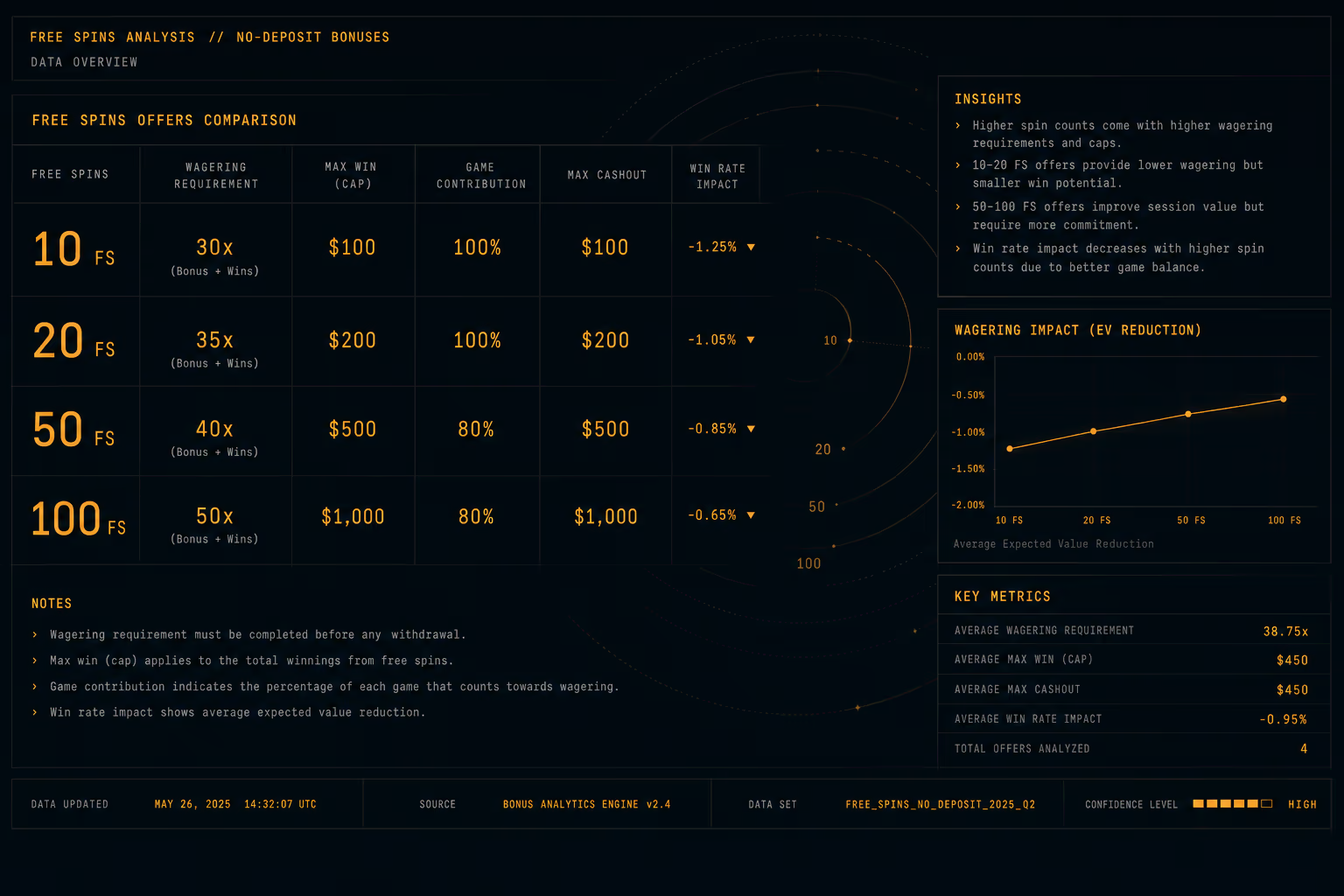
Free spins are the most over-marketed offer
No-deposit free spins are designed to advertise well. “Get 100 free spins, no deposit” reads as a hundred chances at a jackpot, and the count is the only number most players register. The count is also the least informative number in the whole offer. What a free-spins package is actually worth depends on the per-spin value, the slot it is tied to, the winnings cap, and the wagering applied to anything you win — and the operator controls all four to keep the convertible value low while the headline stays high.
This page shows how to take any free-spins offer apart and value it the way BonusScout’s model does, so you can tell a genuinely good package from a large, hollow one.
The per-spin value is the real headline
Every free spin has a fixed stake assigned by the operator, independent of the slot’s normal minimum bet. It is usually stated in the terms — “spins valued at $0.10 each” — and it is commonly $0.10 or $0.20. This is the number that, multiplied by the count, gives the total stake the operator is actually putting in play on your behalf.
So the first move on any offer is the same:
Total stake = per-spin value × spin count.
- 100 spins at $0.10 each = $10 of stake
- 20 spins at $0.50 each = $10 of stake
- 50 spins at $0.20 each = $10 of stake
All three put the same money in play. The spin count alone told you nothing. If the per-spin value is not stated, assume the lowest plausible figure — operators rarely set free spins above $0.20, and never in your favour by accident.
Expected return, before the catches
Once you have the total stake, the rough expected return is that stake times the slot’s RTP (return to player):
Expected return ≈ total stake × RTP.
On $10 of stake at a 96 percent RTP slot, the long-run expected return is about $9.60. That is not profit — it is what the spins are worth on average before any of the bonus catches apply. It already tells you the headline “100 free spins” is, in expectation, worth under ten dollars. The catches only reduce it from there.
The tied slot matters
Free spins are almost always locked to one named slot chosen by the operator, and you cannot move them to a higher-RTP or lower-volatility game. That makes the specific game part of the offer’s value:
- RTP sets the average return. A slot at 96.5 percent returns meaningfully more over many spins than one at 94 percent.
- Volatility sets the shape. On a capped offer, high volatility can be marginally favourable — you only need one big hit to reach the win cap — but it also raises the chance of clearing nothing, which on a no-deposit offer simply means you walk away with zero.
A package tied to a low-RTP, low-volatility slot is worth less than the same count on a high-RTP slot, and the offer terms name the slot, so it is always checkable.
Winnings are bonus funds, not cash
Here is where most of the headline value disappears. In the overwhelming majority of free-spin offers, anything you win is credited as bonus funds, not withdrawable cash. Those funds carry two attachments:
- A maximum-cashout (win) cap — the most you can ever withdraw from the offer, regardless of what you actually win.
- Wagering on winnings — a multiplier you must bet through before the balance converts.
Both are applied to your winnings, and both are why count-led marketing is misleading.
Why “100 free spins” can lose to “20”
Put the full math on two offers with identical $10 stake:
| Offer A | Offer B | |
|---|---|---|
| Spins | 100 | 20 |
| Per-spin value | $0.10 | $0.50 |
| Total stake | $10 | $10 |
| Winnings cap | $50 | $100 |
| Wagering on winnings | 50x | 20x |
| Expiry on winnings | 3 days | 7 days |
Both packages have the same expected gross win. But Offer A caps you at $50 and demands you bet that winning balance through 50 times before withdrawal; if you win the typical small amount, almost none of it survives, and the cap means even a lucky run stops at $50. Offer B lets you keep up to $100, asks for only 20x turnover on winnings, and gives you a week to do it. Offer B is the materially better offer despite having one-fifth of the spins, and our model scores it well above A — wagering (35%) and cash-out headroom (30%) together dominate the result, and B wins both.
This is the single most important habit on free-spin offers: never compare by spin count. Compare by per-spin value, cap, and wagering on winnings.
Wagering on winnings, worked through
If you win $30 from the spins and the offer is 40x wagering on winnings, you must place $1,200 in bets before any withdrawal — and every one of those bets risks the $30 you are trying to keep. The higher the multiplier, the more likely the winnings are gone before they convert. A 50x requirement on a small win is, for practical purposes, an instruction to bet the win back. This is exactly why our scoring weights wagering at 35 percent: it is the factor most likely to turn a “win” into nothing.
The best-scoring free-spin offers either pay winnings as cash with no wagering — rare, and worth seeking out — or apply a low multiplier (under 30x) to winnings with a cap well above the expected win.
The two expiry clocks
Free spins run on two timers, and missing either forfeits the value:
- The spins typically expire 24 to 72 hours after they are credited.
- The winnings then enter their own wagering window, commonly three to seven days.
A short window on heavy wagering is a hidden value cut: 50x on a balance you have three days to clear is far harder than 50x with seven days, even though the multiplier reads the same. Time to clear is 15 percent of our score for this reason.
A checklist for any free-spins offer
- Find the per-spin value in the terms; multiply by count for total stake.
- Note the tied slot and its RTP; estimate expected return as stake × RTP.
- Read the winnings cap — your hard ceiling.
- Read the wagering on winnings and whether winnings are cash or bonus funds.
- Check both expiry clocks.
- Only then judge the offer — and never by spin count alone.
Run an offer through that and you will usually find the convertible value is a fraction of the advertised “100 spins”. A genuinely good package is high per-spin value, generous cap, low or zero wagering, and a reasonable window.
Where this sits
Free spins are one of several no-deposit types we score on the same 0–100 axis. To compare them against cash chips, sweeps grants and crypto offers, see the bonus types hub. The exact weighting and normalisation are on the methodology page, and currently verified, date-stamped offers are listed on the homepage.
Free-spin play is for adults of legal gambling age. A high score reflects favourable terms, not a likelihood of winning — most free-spin sessions on a capped, wagered offer convert little or nothing, and that is the expected outcome, not a fault.