How No-Deposit Bonuses Actually Pay Out

What “no deposit” really means
A no-deposit bonus is the only casino promotion you can claim without funding an account. You register, the bonus credits automatically (or after entering a code), and you can start playing immediately. That is the appeal — and also where most of the misunderstanding starts.
What you receive is not withdrawable money. It is playing credit, almost always with strings attached. The headline — “€10 free”, “50 free spins”, “$25 no deposit” — describes the size of the credit, not the size of the cash you can eventually take out. The gap between those two numbers is where the real value of an offer lives, and it is the gap our scoring model exists to measure.
There are three common shapes:
- Free cash — a fixed bonus balance, e.g. €10 or $25, credited to a separate bonus wallet.
- Free spins — a number of spins on a named slot at a fixed spin value, e.g. 50 spins at €0.10 each.
- Free play / time — a larger nominal balance you must play through within a short window (often an hour), keeping only the net winnings up to a cap.
All three behave the same way once you try to withdraw: winnings are gated behind a wagering requirement, capped by a maximum cash-out, and bound by an expiry clock and a set of game and bet restrictions. Understand those four levers and you understand every no-deposit offer ever written.
This page links to the live offer ledger on the homepage where each bonus is scored, and to two deeper explainers: wagering requirements and maximum cash-out limits.
The full lifecycle of a no-deposit bonus
It helps to follow a single bonus from the moment it lands to the moment cash hits your bank.
1. Claim. The bonus credits to a bonus wallet, kept separate from any real-money balance. At this point the funds are “locked” — they have a wagering target attached and cannot be withdrawn.
2. Play. Every qualifying bet chips away at the wagering target. Only certain games count, and many count only partially (more on weighting below). The bonus balance rises and falls with variance as you play.
3. Clear. When your cumulative qualifying stakes reach the wagering target, the bonus “clears”. The remaining balance — or the portion of it up to the cash-out cap — converts from locked bonus funds into withdrawable cash.
4. Verify. Before paying out, almost every licensed operator runs KYC: identity, address, sometimes a payment method. Many also require a small qualifying deposit before a no-deposit withdrawal is released. Skipping this step is the most common reason a “cleared” balance never arrives.
5. Withdraw. You request a payout up to the maximum cash-out. Anything above the cap is stripped. The sticky bonus amount itself is typically deducted at this stage, so you withdraw winnings, not winnings-plus-bonus.
Miss a condition at any stage — overshoot the max bet, let the timer run out, touch an excluded game — and the casino can void the bonus and everything won from it. The lifecycle is unforgiving by design.
Wagering requirements: the playthrough formula
The wagering requirement is the headline obstacle, expressed as a multiplier: 30×, 45×, 60×. It tells you how much you must stake in total before a withdrawal is allowed.
The formula every reader should memorise:
estimated playthrough = bonus value × wagering multiplier
Worked example one: €5 of free spins at 60× wagering. Playthrough = €5 × 60 = €300. You must cycle €300 of bets through the slots before any withdrawal. Now suppose the max cash-out is €50. You are grinding €300 of stakes for the chance at a €50 ceiling — and slot variance means most players’ bonus balance hits zero long before €300 is staked. That is a structurally poor offer, and our model grades it harshly.
Worked example two: $22 free cash at 25× wagering with a $100 cap. Playthrough = $22 × 25 = $550 of stakes. That sounds higher, but the lower multiplier relative to a larger, more flexible cap changes the picture: more of any win you do book is actually withdrawable (up to $100, not $50), so the headroom between effort and reward is far healthier. This offer grades well above the first despite a bigger raw playthrough number.
The lesson: a wagering multiplier in isolation is meaningless. It only matters against the cash-out cap and the bonus size — which is exactly why our score weighs them together rather than ranking on “lowest wagering wins”. The deeper mechanics, including bonus-only versus deposit-plus-bonus wagering and “sticky” balances, are covered in wagering requirements explained.
Game weighting: why your bets don’t all count equally
Wagering rarely counts at face value across all games. Each game category carries a contribution percentage:
| Game type | Typical contribution |
|---|---|
| Slots | 100% |
| Keno / scratch | 100% (often) |
| Video poker | 10–20% |
| Roulette | 5–25% (often excluded) |
| Blackjack | 5–10% (often excluded) |
| Baccarat / craps | 0–10% |
| Live dealer | 0–10% (frequently excluded) |
If a bonus has a 30× requirement on a €5 credit, that is €150 of contributing stakes on slots. But on blackjack at 10% contribution, every €1 staked only counts as €0.10 toward the target — so you would need to stake €1,500 to clear the same bonus. This is why “no deposit + table games” is almost always a trap: the weighting quietly multiplies the real playthrough by 10× or more.
The practical rule: clear wagering on the games that count 100% (slots), and treat any excluded-game clause as a hard “do not play” while the bonus is active — a single excluded-game bet can void the whole bonus, not just fail to count.
Maximum cash-out: the ceiling on everything
The maximum cash-out (also “max win” or “withdrawal cap”) is the most-skipped line in the terms and the one that decides real value. Typical no-deposit caps sit between $50 and $200.
Here is why it matters more than the bonus size. Imagine you beat the odds: you clear a €10 no-deposit bonus and your balance swells to €400. If the cap is €100, you withdraw €100 and forfeit €300. Your upside was never €400 — it was always €100, no matter how lucky the run. The cap is the true measure of “best case”, and a fat bonus with a thin cap is a smaller offer than it looks.
The cap also interacts with wagering. A €5 bonus at 60× with a €50 cap asks for €300 of stakes to reach a €50 ceiling — effort and reward are badly mismatched. The same €5 at 25× with a €150 cap is a different proposition entirely. We unpack the scenarios, including the “win big then get capped” and “grind to zero” cases, in maximum cash-out limits.
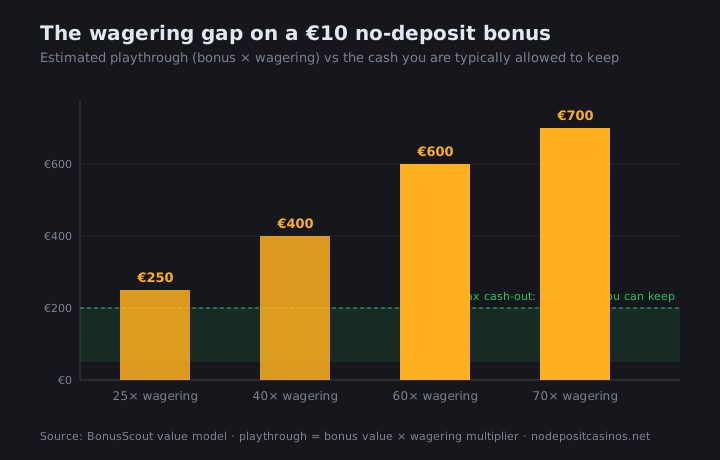
Want to reuse this chart? Copy the embed:
<a href="https://nodepositcasinos.net/how-payouts-work/"><img src="https://nodepositcasinos.net/img/wagering-vs-cashout.svg" alt="The wagering gap on a no-deposit bonus — BonusScout" width="720" height="460"></a>Bonus and free-spin value, normalised
To compare a 50-spin package against a $25 cash bonus fairly, you have to convert spins to a cash-equivalent. We use the stated spin value: 50 spins at €0.10 = €5 equivalent. If the spin value is not disclosed, we treat it conservatively at the slot’s minimum stake. Everything is then normalised to a single currency so the ledger ranks offers on a level field rather than rewarding whichever promotion shouts the biggest number.
A subtle point most players miss: free-spin winnings are often capped a second time — both by the wagering on the converted balance and by the overall max cash-out. A spins offer with a €5 equivalent, 40× wagering and a €50 cap is doing more limiting than its cheerful “50 FREE SPINS” banner suggests.
Expiry windows and the max-bet rule
Two terms do quiet damage:
Expiry window. The clock on clearing wagering runs from claim, not from first play. A 24-hour window on a 60× requirement is brutal — there are simply not enough hours to cycle the required stakes at sensible bet sizes. A 7-day or 30-day window on the same requirement is far more clearable. Our model rewards longer windows precisely because time is what makes a high multiplier survivable.
Max bet while bonus active. Almost universally, your stake is capped while a bonus is live — commonly $5 per spin or hand. Exceed it once, even accidentally on an autospin, and the operator can void every winning. This rule exists to stop players clearing wagering in a few large bets, and it is enforced strictly. Treat the max-bet figure as the single most important compliance number in any bonus.
Common terms that quietly kill value
The clauses that turn a good-looking offer into a bad one are rarely on the banner. Watch for:
- Restricted/excluded games — playing one can void everything, not just fail to contribute.
- Country and currency restrictions — some offers exclude your region or pay out in a worse currency.
- Single-bonus-per-household rules and IP/device matching, which void duplicate claims.
- Winnings forfeited on first real-money withdrawal — a few terms wipe leftover bonus winnings the moment you cash out a deposit.
- Qualifying deposit before withdrawal — common, and not the same as the bonus being “free to keep”.
- Bonus deducted at cash-out (sticky) — you keep winnings minus the original bonus.
None of these are scams when disclosed; they are the price of money with no deposit at risk. Our job is to surface them and price them into a single number.
How we grade every offer
Every offer in the ledger receives a No-Deposit Value (NDV) score from 0 to 100, built from four weighted factors. The weights reflect what actually determines whether a player can realistically convert a bonus into cash.
| Factor | Weight | What it measures |
|---|---|---|
| Wagering burden | 35% | How much you must stake to clear. Lower is better; genuine no-wagering scores at the top. |
| Cash-out headroom | 30% | The max-cashout cap relative to the bonus size — how much of a win you can actually keep. |
| Bonus size | 20% | Headline value, normalised to one currency so spins and cash compare fairly. |
| Time to clear | 15% | Length of the clearance window. Longer scores higher; a 1-day window on 60× is brutal. |
The weighted sum lands on a 0–100 score, which maps to a letter grade:
- A — 80 and above: strong real value; effort and reward are well matched.
- B — 70 to 79: good, with one mild drawback.
- C — 60 to 69: workable but compromised — usually high wagering or a tight cap.
- D — 50 to 59: poor; the terms eat most of the headline value.
- F — below 50: avoid; the math rarely lets a player reach the cap.
A worked comparison
Take two offers that look similar on a banner and score very differently:
Offer A — €5 free spins, 60× wagering, €50 max cash-out, 24-hour window. Playthrough is €5 × 60 = €300 of stakes, against a €50 ceiling, inside a single day. Wagering burden scores low (35% weight, heavily penalised). Cash-out headroom is poor — €50 cap on €5 is a modest 10× ratio but the wagering swamps it. Bonus size is small. Time to clear is the worst case. Net result: an F, mid-40s. The numbers simply do not let most players reach payout.
Offer B — $22 free cash, 25× wagering, $100 max cash-out, 7-day window. Playthrough is $22 × 25 = $550 of stakes — a bigger raw figure — but spread over a week, at a contribution-friendly 100% on slots, toward a $100 ceiling. Wagering burden scores well (the 25× multiplier is moderate). Cash-out headroom is healthy. Bonus size is larger. Time to clear is generous. Net result: a B, around 74. Despite the larger playthrough number, the realistic path to a meaningful withdrawal is far clearer.
The comparison captures the model’s whole point: the multiplier alone lies; value is the relationship between burden, headroom, size and time. That relationship is what the NDV score compresses into a single, comparable number.
A closing note on realism: no score predicts an individual outcome. Slot variance means many players will clear nothing from even an A-grade offer, and no bonus is guaranteed money. The score ranks structure — which offers give a fair shot, and which are built so the player rarely reaches the cap.
Where to go next
Start with the live offer ledger to see current scores and date stamps. Then read the two mechanics deep-dives that feed the model: wagering requirements explained and maximum cash-out limits on no-deposit bonuses. Together they cover everything that sits between a bonus landing in your wallet and cash landing in your bank — for players 18 and over.