Maximum Cash-Out Limits on No-Deposit Bonuses
What a maximum cash-out is
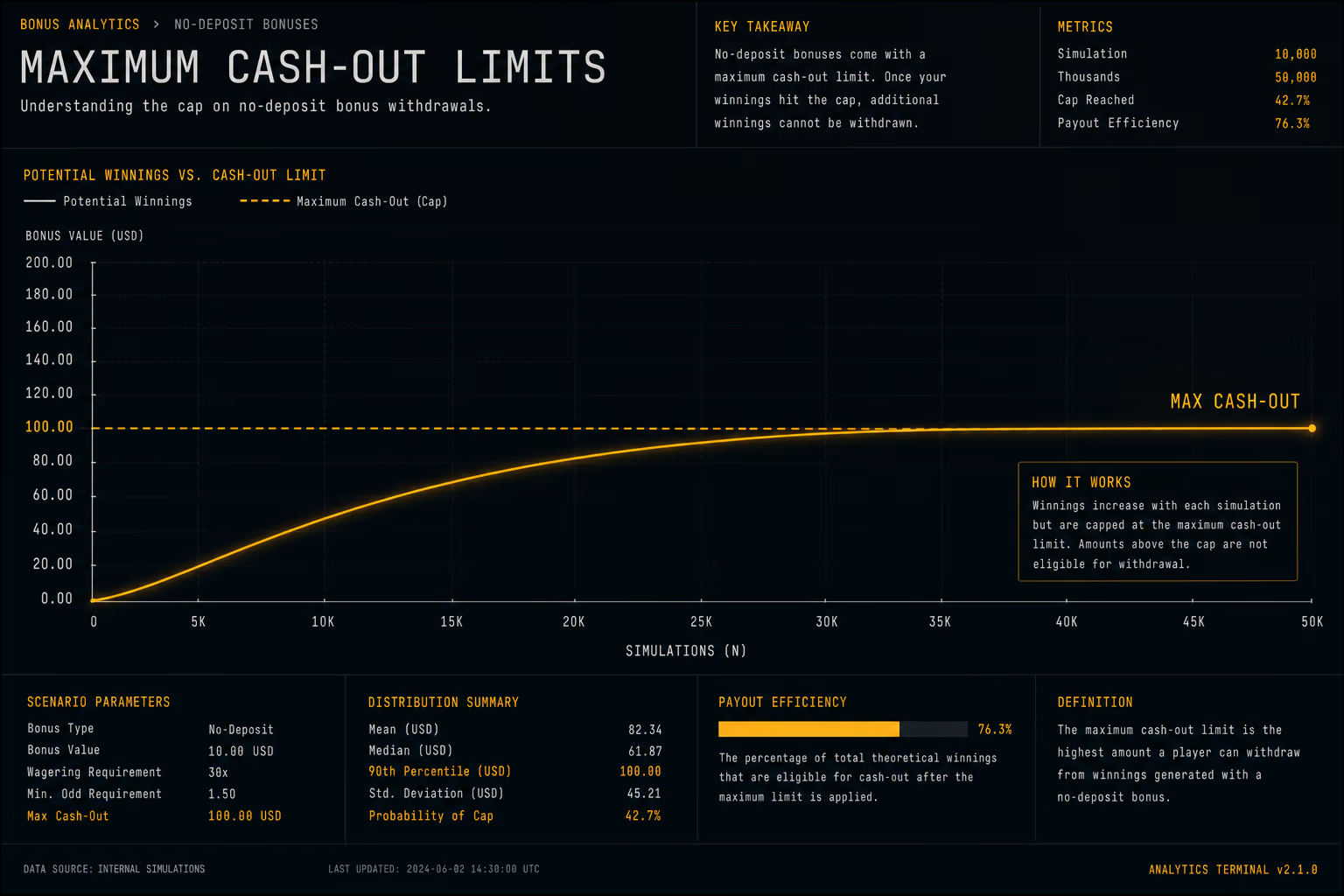
The maximum cash-out — also called the max win, withdrawal cap, or “winnings capped at” — is the hard ceiling on how much you can withdraw from a no-deposit bonus, no matter how much you win along the way. It is the single most important number in a no-deposit offer and the one most often skipped, because it never appears on the banner. The banner shouts the bonus size; the cap, buried in the terms, decides what that bonus is actually worth.
Typical caps sit between $50 and $200. Free-spin packages cluster at the lower end ($50–$100); larger free-cash bonuses occasionally stretch to $200. A handful of offers cap as low as $20, and a rare few have no cap at all (almost always paired with steep wagering to compensate).
This explainer pairs with wagering requirements explained and sits under the main guide, how no-deposit bonuses actually pay out. Current scored offers live on the homepage ledger.
Why the cap exists
A no-deposit bonus is the only promotion where the player risks nothing and the casino funds everything. The operator’s total exposure per claim is, by design, the cap. If 10,000 people claim a $25 bonus with a $100 cap, the worst case is bounded — the cap is the cost-control lever that makes “free money” sustainable as marketing.
That is not a trick when it is disclosed; it is the price of money with no deposit at risk. The problem is purely one of expectations. Players read “win up to whatever you can” into a bonus that, in writing, says “win whatever you like — keep at most $100”. Understanding the cap up front prevents the most common disappointment in the entire category.
How the cap caps real value
Consider the win-big scenario. You claim a €10 no-deposit bonus, hit a lucky run, and your balance climbs to €400. The cap is €100. At withdrawal:
- Winnings above the cap (€300) are stripped.
- On a sticky bonus, the original €10 is also deducted.
- You withdraw €100 (or €90 depending on how the sticky deduction is applied).
Your upside was never €400. It was €100 from the moment you claimed. The lucky run did not raise your ceiling — it only reached it faster. This is the core insight: the cap, not the headline, defines best case. A €50 bonus with a €50 cap has a smaller realistic top end than a €10 bonus with a €100 cap, even though the first looks five times bigger.
Now the lose scenario, which is far more common. Most players never approach the cap at all, because high wagering empties the balance first. The cap only bites the lucky minority; the majority are limited by variance and playthrough long before the ceiling is in view. That is why the cap must always be read together with the wagering requirement, not in isolation.
Cap × wagering: the value ratio
The cash-out cap and the wagering multiplier jointly set the effort-to-reward ratio, which is what our scoring model prices.
Poor pairing: €5 bonus, 60× wagering, €50 cap. Playthrough is €5 × 60 = €300 of stakes to chase a €50 ceiling. You grind €300 through the slots for a €50 best case — and most balances die before €300 is cycled. Effort hugely exceeds reward. In our model this scores in the F band.
Healthy pairing: $22 bonus, 25× wagering, $100 cap. Playthrough is $22 × 25 = $550 of stakes, but toward a $100 ceiling with a moderate multiplier and (typically) a longer window. More of any win you book is keepable, and the lower multiplier gives the balance a real chance to survive to clearance. This scores in the B band despite the larger raw playthrough.
The takeaway mirrors our wagering guide: neither number means anything alone. A big cap on a small, heavily-wagered bonus is a mirage; a fair cap on a moderately-wagered bonus is where genuine value lives. Our model devotes 30% of the score to cash-out headroom — the cap measured relative to bonus size — precisely because the cap is where so much hidden value is won or lost.
Spotting the cap in the terms
The cap hides under several names. Search the bonus terms for any of these:
- “Maximum withdrawal” / “max withdrawal from bonus”
- “Maximum cash-out” / “max cash-out”
- “Max win” / “winnings capped at”
- “The maximum amount that can be withdrawn from this bonus is…”
A few practical checks before you claim:
- Is the cap a flat figure or a multiple of the bonus? Some terms express it as “max win = 10× the bonus”, which scales with bonus size — useful to know.
- Does the cap apply per claim or per day? Per-claim is standard; the cap does not reset by clearing wagering again.
- Does a later deposit lift the cap? On some offers the cap applies only to the no-deposit portion, and winnings from a subsequent real-money deposit are uncapped. This is operator-specific — confirm it in writing.
- Free-spin double cap. Spin winnings are often capped twice: once when converted to a bonus balance and again by the overall max cash-out. Read both.
Worked scenarios
Scenario A — the capped jackpot. €5 free spins, 40× wagering, €50 cap. You clear wagering (€200 of stakes) and your balance is €180. You withdraw €50; €130 is forfeited. The win felt large; the payout was capped at a tenth of it. Pre-claim, the realistic ceiling was always €50.
Scenario B — the modest, clearable win. $25 free cash, 25× wagering, $150 cap, 7-day window. You clear ($625 of stakes over a week on slots) and finish at $90. You withdraw the full $90 — comfortably under the cap, so nothing is lost. Here the cap never bit; wagering and variance set the outcome. This is the profile of a well-graded offer: the cap is high enough that it rarely becomes the limiting factor.
Scenario C — the unreachable ceiling. $50 free, 50× wagering, $200 cap, 24-hour window. The headline is the most generous of the three. But $50 × 50 = $2,500 of stakes inside one day, under a $5 max bet, is not achievable for almost anyone — the bonus expires mid-grind. A high cap is worthless if the wagering and window never let you near it. Our model grades this low despite the attractive cap, because headroom you cannot reach is not headroom.
Bottom line
The maximum cash-out is the true measure of a no-deposit bonus’s best case, and it only makes sense alongside the wagering requirement and the clearance window. A generous cap on a small, heavily-wagered bonus rarely pays; a fair cap on a moderately-wagered bonus, with time to clear, is where realistic value sits. That relationship is exactly what the scoring model compresses into a single number. To see how the wagering side of the equation works, read wagering requirements explained, and check the current scored offers on the homepage. For players 18 and over — no bonus is a guaranteed return; the cap defines the most you could keep, not what you will win.