No-Deposit Cash Bonuses and Free Chips
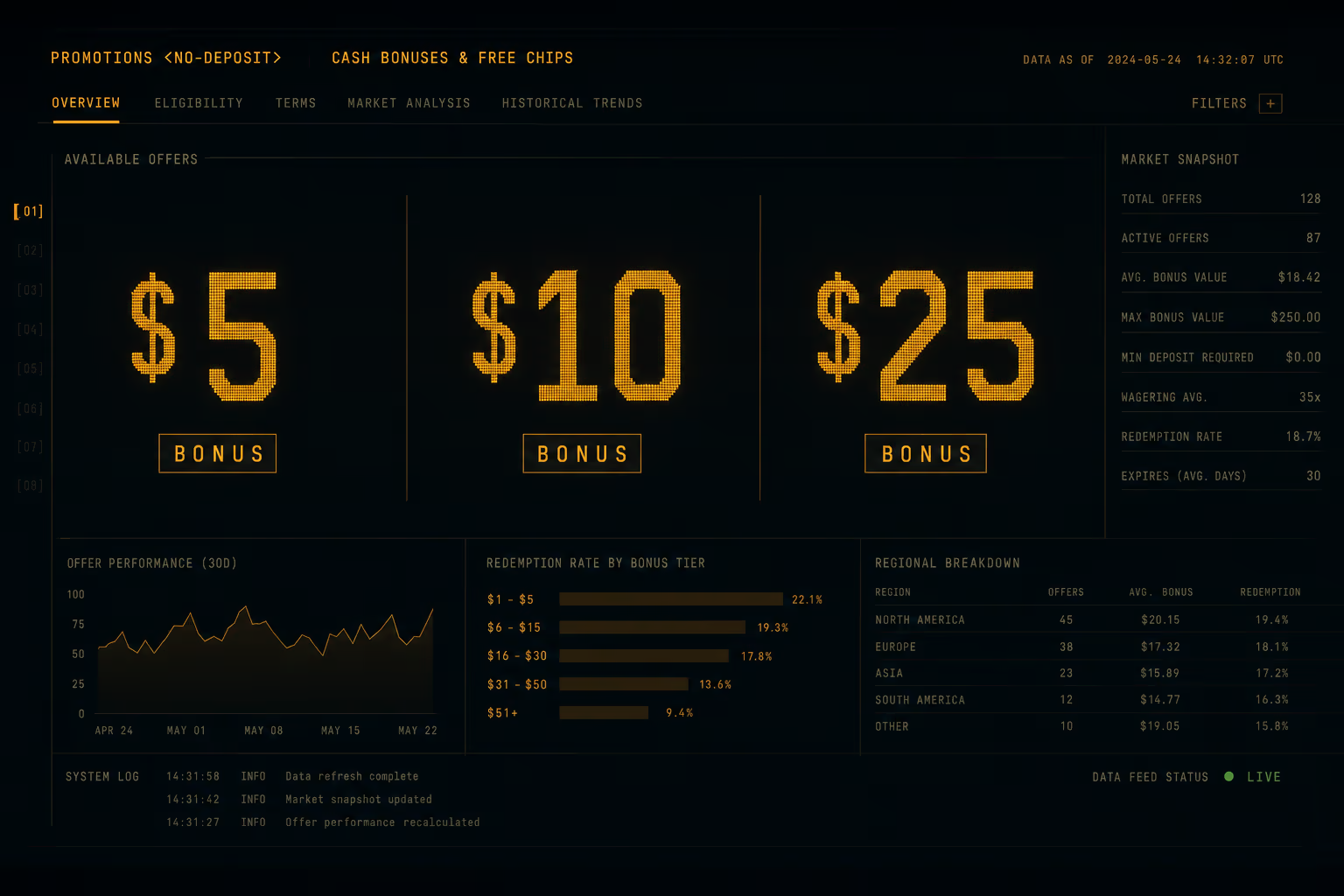
A balance you actually control
A no-deposit cash bonus, or free chip, is the most straightforward no-deposit offer: a small balance of bonus funds — usually $10 to $50 — dropped into your account with no deposit, and usable across the operator’s eligible games rather than tied to one slot. “Free chip” and “free cash” are the same product under different names; the chip label is just more common at casinos with table-game heritage.
Because the amount is real money under your control, and the wagering attaches to a known balance rather than to uncertain spin winnings, these offers convert more transparently than free spins and tend to score higher in our model. But “tend to” is not “always” — a cash bonus loaded with 60x wagering and a $50 cap can still score below a well-built free-spins package. The value, as ever, is in the interaction between wagering and max-cashout, not the headline.
The two numbers that decide everything
Every cash offer comes down to two figures the marketing buries:
- Wagering multiplier — applied to the bonus amount. A $50 bonus at 40x means $2,000 of total bets before the balance is withdrawable.
- Max-cashout (win cap) — the ceiling on what you can take out, regardless of how much you win.
The headline amount feeds into both but decides neither on its own. This is why bonus size is only 20 percent of the BonusScout score, while wagering is 35 percent and cash-out headroom is 30 percent: a large chip with punishing wagering and a low cap converts to less than a small chip with light wagering and a high cap.
Why a $50 chip at 40x beats a $75 chip at 60x
This is the central lesson of cash bonuses, so it is worth working in full:
| Offer A | Offer B | |
|---|---|---|
| Bonus amount | $50 | $75 |
| Wagering | 40x | 60x |
| Required turnover | $2,000 | $4,500 |
| Max-cashout | $200 | $100 |
| Max bet while wagering | $5 | $5 |
Offer B has the bigger headline — 50 percent more free money. But to convert it you must put $4,500 through the games at no more than $5 a bet, which is 900 minimum bets, and even if you win, you can withdraw at most $100. Offer A asks for $2,000 of turnover (400 bets at the $5 cap), less than half the grind, and lets you keep up to $200 — double B’s ceiling.
So Offer A is both far easier to clear and far more rewarding if you do. In our model A scores well above B: it wins the wagering factor (35%) decisively and the cash-out-headroom factor (30%) outright, and those two together outweigh B’s lead on size (20%). The “bigger” bonus is the worse offer.
Game weighting and the eligible-games list
Wagering is rarely uniform across games. Most cash bonuses weight contributions:
- Slots almost always count 100 percent toward the requirement.
- Blackjack, roulette, video poker often count 10 to 20 percent, or are excluded entirely.
The reason is the house edge: low-edge table games would let you clear a requirement cheaply, so operators discount or bar them. This means the eligible-games list is part of the offer’s real value. A $50 chip that lets you clear on a 96.5 percent RTP slot is worth more than one that forces a high-edge game, and playing an excluded game can void the bonus outright.
The max-bet rule is a hidden time cost
Almost all cash bonuses cap the stake per bet while wagering — commonly $5. The purpose is to stop you clearing $2,000 of turnover in a handful of large bets. The effect is that even a modest requirement becomes hundreds of individual spins, which lengthens the time to clear and exposes the balance to more variance along the way. Breaching the max bet, even once, typically voids the entire bonus and any winnings. Because a short clearing window combined with a low max bet can make a requirement practically impossible, time to clear is 15 percent of our score.
Free play time and starting bankrolls
A related sub-type gives a block of time — “60 minutes free play” — or a large temporary bankroll, then lets you keep winnings above or below a defined threshold as convertible cash. The play balance can look enormous, but the value is entirely in the convertible ceiling: the cap on what you can actually carry out. We score these exactly like cash offers, on what survives to withdrawal rather than on the headline play balance, and the same wagering-versus-cap logic applies.
How to value any cash or chip offer
- Read the wagering multiplier and compute required turnover: amount × multiplier.
- Read the max-cashout — your hard ceiling on winnings.
- Check the eligible-games list and weighting — can you clear on a high-RTP slot?
- Check the max bet while wagering and the clearing window.
- Compare offers on turnover and cap, never on headline amount.
A genuinely strong cash offer is a sane multiplier (ideally 25x to 40x), a cap several times the bonus amount, slots counting fully toward wagering, and a comfortable window. The rare offers that pay the bonus as immediately withdrawable cash with no wagering sit at the very top of our model.
Where this sits
Cash and chip offers are one of several no-deposit types we score on the same 0–100 axis; compare them against free spins, sweeps grants and crypto offers on the bonus types hub. The exact weighting is documented on the methodology page, and currently verified, date-stamped offers are listed on the homepage.
No-deposit play is for adults of legal gambling age. A high score reflects favourable terms — a low multiplier and a generous cap — not a likelihood of profit. Most wagered bonuses convert little, and that is the expected outcome.