Are No-Deposit Bonuses Worth It? The Honest Answer
The short, honest answer
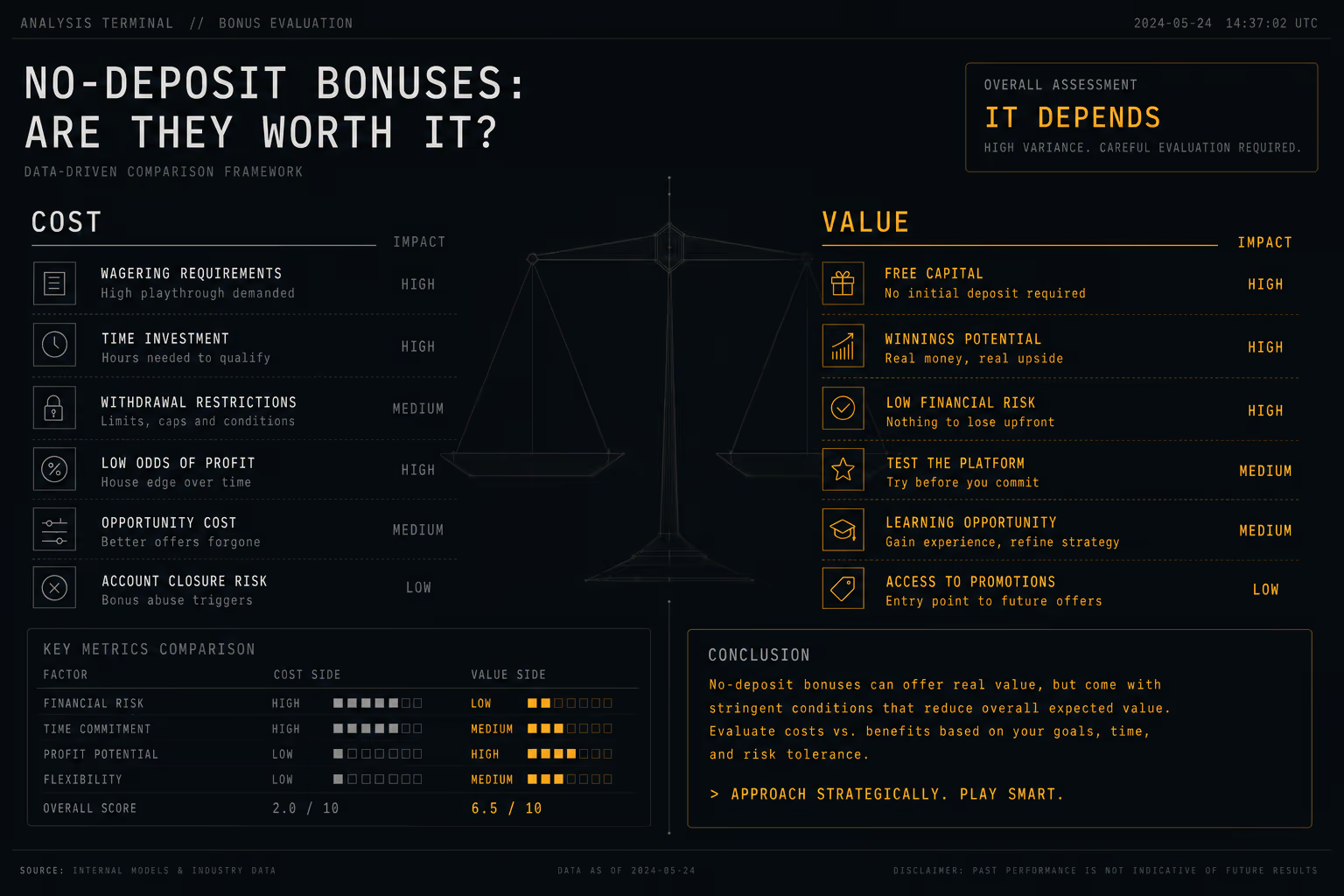
Most no-deposit bonuses are worth less than they look, and a meaningful share are worth nothing at all. That is not cynicism — it is what the terms add up to once you do the arithmetic the headline skips. But “most” is not “all.” A minority of offers carry genuinely favourable terms and are worth a short, eyes-open session. The job of this page, and of the value score behind every offer on the homepage ledger, is to separate the two so you do not waste time on the rest.
No-deposit bonuses are entertainment offers, not income. Nothing here promises or implies a return; on average the math favours the casino, which is precisely why a clear value read matters before you commit any time.
The realistic expected value
Take a representative offer: a $20 no-deposit bonus, 40x wagering, $100 maximum cash-out. The headline says $20 free. Here is what the terms say.
A 40x requirement on a $20 bonus means $800 in total stakes before any winnings can be withdrawn. Across that $800 of turnover on eligible slots — which typically run around 96% RTP — the expected house edge steadily erodes the balance. The expected outcome of grinding through $800 of wagering starting from $20 is, far more often than not, a balance of zero before the requirement is met. On the runs where you do reach the end with money left, the $100 cap then removes anything above it.
So the realistic expected withdrawable amount on a typical offer is a few dollars at best, and frequently nothing. The headline figure and the expected figure are not in the same ballpark. This is not a trick unique to bad casinos; it is the structural reality of how no-deposit bonuses are priced. The value score exists to make that reality visible at a glance instead of after a wasted hour.
The red flags that gut an offer
Four traits drag an offer’s real value down. Individually each is a cost; in combination they can take an offer to effectively zero.
- High wagering (50x and up). This is the biggest single drag, which is why it carries 35% of the score. A 60x requirement on a $25 bonus is $1,500 in turnover — enough that the house edge will, in expectation, consume the balance before you finish.
- A low cash-out cap. A cap equal to or barely above the bonus quietly caps your entire upside. Win $400 on a lucky run under a $50 cap and you keep $50. The cap, not your luck, sets the ceiling — hence its 30% weight.
- A short expiry window. A 24- or 48-hour window against a high wagering requirement can be mathematically impossible to clear at a sane stake size. Time to clear is 15% of the score for this reason: a requirement you cannot physically meet in the window is worth nothing.
- A deposit-to-withdraw clause. This turns “no deposit” into “no deposit, then a deposit.” It is not automatically disqualifying, but it changes the offer materially and is easy to miss in the terms.
The dangerous case is the stack: high wagering and a low cap and a short window and a deposit clause. An offer like that can carry a large, attractive headline and be one of the worst deals on the board. The score is built to expose exactly this — which is why headline size is only 20% of it.
Why bigger is often worse
It is counterintuitive, but a larger no-deposit bonus is frequently the worse deal, because casinos offset a generous headline with harsher terms. Compare two offers:
| Offer A | Offer B | |
|---|---|---|
| Bonus | $50 | $10 |
| Wagering | 60x | 25x |
| Turnover to clear | $3,000 | $250 |
| Max cash-out | $50 | $100 |
| Realistic verdict | Hard to clear, low ceiling | Easy to clear, higher ceiling |
Offer A’s headline is five times bigger, yet it demands twelve times the turnover and caps your winnings at half of Offer B’s. The smaller offer is both more clearable and more rewarding. A player reading headlines picks A; a player reading terms picks B; the value score picks B too. That is the entire case for scoring offers on their terms rather than their size.
When a no-deposit bonus IS worth claiming
There is a real “yes.” An offer is worth your time when the terms line up:
- Low wagering — roughly 20x–30x or below, low enough that clearing it is realistic rather than aspirational.
- A cash-out cap that is a healthy multiple of the bonus rather than equal to it, so a good run actually pays.
- An expiry window long enough to clear the wagering at a sensible pace — a week or more, not 24 hours.
- Eligible games with decent RTP, and a reasonable maximum bet that lets you stake efficiently.
- No deposit-to-withdraw clause, so “no deposit” means what it says.
Offers that tick these boxes score well, grade well, and are worth a short, capped session for the entertainment plus a genuine if modest chance of a small withdrawal. They are the minority — and finding them quickly is exactly what the ledger and the score are for.
When to skip it
Skip the offer when:
- Wagering is high and the window is short — often impossible to clear in practice.
- The cap is equal to, or barely above, the bonus — your upside is negligible whatever happens.
- There is a deposit-to-withdraw clause you have no interest in meeting.
- The value score is simply low. A low score is the site telling you, in one number, that the time is better spent elsewhere.
There is no obligation to claim every offer that appears. Most days, the right move on most offers is to pass.
How to use the score to decide
The value score compresses all four factors — wagering (35%), cash-out headroom (30%), bonus size (20%), time to clear (15%) — into one 0–100 number and an A–F grade. A high score means the terms genuinely favour the player; a low score means the headline is hiding restrictive terms. Used well, it lets you discard the bad offers in seconds and spend your attention only on the few worth claiming.
So: are no-deposit bonuses worth it? A few are, most are not, and the honest answer for any specific offer is the one its terms give you. Read the offer in full on the homepage, check its score, and when you decide to go ahead, follow the step-by-step claim guide so you do not lose on a technicality what the terms allow you to keep. All five guides live on the guides hub.