No-Deposit Bonus Codes: How They Work
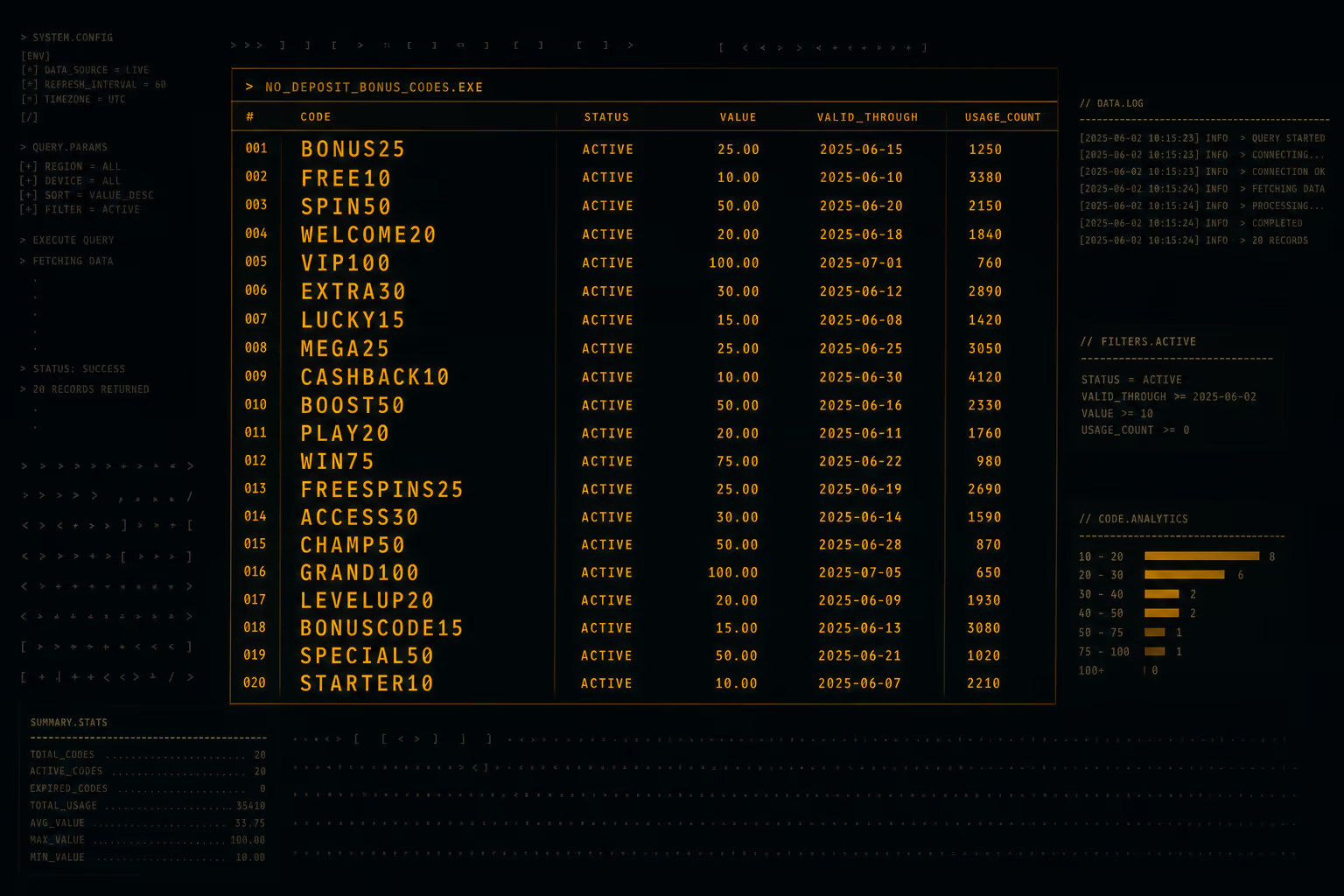
What a no-deposit bonus code actually is
A no-deposit bonus code is a short string — something like WELCOME25, FREE50 or SPINS20 — that you type into a casino to unlock a particular no-deposit offer. That is all it is: a key. It carries no value on its own. What gives an offer its worth is the set of terms the code unlocks — the wagering requirement, the maximum cash-out cap, the expiry window and the eligible games — and those live in the casino’s offer terms, not in the code.
This distinction is the single most useful idea in this guide, because the entire codes ecosystem is built to make you focus on the string instead of the terms. Coupon sites publish lists of codes; forums trade them; the same casino can change what a given code unlocks from one month to the next. A code that reads BONUS100 tells you nothing about whether the offer behind it is good. You only know that by reading its terms and checking its value score.
Code vs automatic credit
There are two ways a no-deposit offer reaches your account, and which one applies is decided by the casino, not the size of the offer.
Automatic credit. Once you register and verify your email and phone, the bonus appears on its own with no code entered. Casinos use this when an offer is open to everyone who signs up and they want the lowest-friction path possible.
Code required. The offer stays locked until you enter a specific code. Casinos use codes when they want control: to ring-fence an offer for a particular campaign, region, referral partner or landing page, or to run several different no-deposit offers in parallel without them colliding. A code lets the casino say “this offer, these terms, for this audience.”
On the homepage ledger, an offer that needs a code shows it in its own column. If that column is blank, the offer is automatic — and in that case you should enter nothing, because a stray code on an automatic offer can block it.
Where to enter a code
A valid code can still fail if it goes in the wrong place. There are two standard locations:
- During registration. A field labelled “promo code,” “bonus code” or “coupon” on the signup form. Enter it before submitting the form.
- In the cashier, after signup. A “redeem coupon” or “redeem code” field inside the cashier or account area. This is common for offers you claim after your account already exists.
The casino’s offer terms state which location applies. Two further mechanics catch people out constantly:
- Codes are usually case-sensitive.
Welcome25andwelcome25are not the same string to most systems. - Spaces break codes. Copying a code from a web page often drags a trailing space or a line break with it. The system reads that as a different, invalid string. If a code you are sure is correct fails, re-type it by hand before concluding it is dead.
Why codes expire
Bonus codes are not permanent, and an expired code is the normal end of a campaign rather than a problem with the casino. Codes expire for three main reasons:
- Time-limited campaigns. A code is set live for a promotion, a season or a holiday, and retired when that window closes.
- Redemption caps. Many codes are limited to a fixed number of redemptions or a fixed budget. Once the allocation is used up, the code stops working — sometimes well before its stated end date.
- Replacement. Casinos rotate codes to refresh campaigns or to cut off codes that have leaked too widely across coupon sites. The old code dies the moment the new one goes live.
The practical consequence: a code’s stated expiry date is an upper bound, not a guarantee. A code can be dead before its end date because the redemption cap was hit. This is exactly why a date-of-verification is more useful than an advertised expiry.
Active vs expired: how to tell
There is one authoritative test and one strong signal.
The authoritative test is the casino’s own current offer terms. A code is live only if the casino still honours it, and only the casino’s live offer page can confirm that. Whatever you read elsewhere, the casino’s current terms are the final word — on whether the code works and on what it unlocks.
The strong signal is a recent verification date. On the homepage ledger, every code carries the date a person last confirmed it against the casino’s published terms. A code verified a few days ago is far more likely to be live than one floating uncredited on a coupon site. But a date stamp is a snapshot of one moment, not a live status light — codes can be retired between checks, so treat the date as “last confirmed working” and re-read the casino’s terms before you claim. Nothing on this site is a live feed; codes are checked and refreshed by hand.
Be especially wary of codes copied across forums and coupon aggregators. Those lists are rarely maintained, and a code reposted there is frequently expired, region-mismatched, or attached to terms that have since changed. Treat any code you did not get from the casino or from a dated, verified source as unconfirmed until you check it yourself.
One-per-account rules
No-deposit codes are almost always single-use per account, and they sit inside the broader rule that governs all no-deposit bonuses: one per person, household, IP address, device and payment method. A code that worked once on your account will be refused a second time, and the same code used to claim on a second account is detected through those signals and treated as abuse — grounds for forfeiting winnings and closing the accounts.
Two related limits worth knowing:
- Region locks. Codes are frequently restricted by country. A code advertised for one market will be rejected on an account registered elsewhere. Using a VPN to evade this breaches the terms and is a routine reason winnings are voided — it is never a safe workaround.
- Eligibility. A no-deposit code is usually for new customers only. Existing players, and players who already hold an account at a sister brand under the same operator, are commonly excluded even if the code itself is live.
How we list codes here
Every offer in the homepage ledger that requires a code shows that code in its own column, next to the date a person last confirmed it against the casino’s published terms. The code, the wagering requirement, the cash-out cap, the expiry and the value score all sit in the same row, so you can judge the offer behind the code rather than the code in isolation. Codes are verified and refreshed manually — there is no live feed and nothing auto-updates — which is why the date stamp matters: it tells you precisely how current that one entry is.
To actually claim a coded offer once you have found it, follow the step-by-step claim guide, which covers the exact mechanics of entering a code and the verification that follows. To understand why an offer scores the way it does, read the methodology. And to decide whether a coded offer is worth your time at all, the worth-it guide is the honest counterweight to the headline. All five guides are collected on the guides hub.